Bennett University’s TSOM Deputy Dean Dhiraj Singh to Portray Rabindranath Tagore in Prestigious Dance Drama
Times of Bennett | Updated: Mar 17, 2026 13:43
Correspondent: Vignesh Iyer
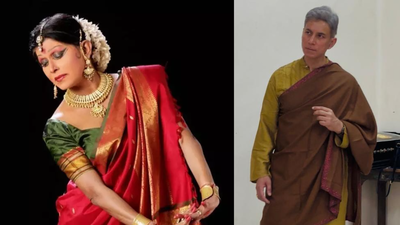
In a moment of immense pride for the Bennett University community,Dhiraj Singh , Deputy Dean of the Times School of Media (TSOM), has been invited by Padmashri Kathak guru Dr. Shovana Narayan to play the lead role of Nobel Laureate Rabindranath Tagore in the
upcoming dance drama, ‘Kadambari : The Poet’s Muse’. The performance is scheduled for March 18, 2026, starting at 7:00 PM at the iconic Kamani Auditorium in New Delhi.
In an era where generative AI and digital disruption are redefining the landscape of higher education, Bennett University (BU) is making a bold statement on the enduring power of human creativity. Dhiraj Singh, Deputy Dean of the Times School of Media (TSOM), is set to
portray Nobel Laureate Rabindranath Tagore in the high-profile dance drama ‘Kadambari: The Poet’s Muse’.
While the university is known for its industry-relevant academic programmes, this collaboration highlights the diverse artistic calibre of its faculty. Dhiraj Singh will perform opposite Guru Shovana Narayan, who takes on the role of Kadambari Devi, Tagore's sister-in-law and his most profound creative influence. The dance-drama is directed by Shovana Narayan.
The AI begins to automate technical skills, the global education discourse has shifted toward the so-called soft skills: empathy, vulnerability and deep creative intuition. Prof. Singh views his collaboration as a step in that direction.
The performance marks a significant cultural milestone, bridging the gap between media education and the classical arts. It underscores
the university's mission to foster a holistic environment for both students and faculty.
Speaking about his role Prof Dhiraj Singh said: “Kadambari: The Poet’s Muse looks at the early years of Rabindranath Tagore who’s still
finding his artistic voice so in a way it was less challenging. He is not Gurudev yet. Since I am an actor who’s not a trained dancer I had some apprehensions about that but Shovana ji made sure those were gone in a first rehearsal itself.”
Rooted in the idiom of Kathak and enriched byRabindra Sangeet , the dance-drama seeks to explore not only a relationship but an entire
cultural ethos. Shovana Narayan believes that revisiting Tagore today is not only about nostalgia but an exploration of ideas that remain startlingly contemporary. “Today we are talking about an integrated education system. But it was always there in our scriptures. Tagore created that environment at Santiniketan long ago, where philosophy, education, performing arts and literature were all breathing the same ethos.”
Tagore is often described as a symbol of modern Indian consciousness, right from the national anthem to him being a giant in the
Indian literary firmament very early on. But Kadambari, the play, goes behind the scenes looking at his vulnerabilities, his awakening into the world of ideas and relationships, power dynamics and of course love so in that sense it is going into areas not explored much especially in classical dance that tends to be more traditional.
The performance combines dance, narrative and theatre. What would be the most valuable takeaway for viewers? “I think the most valuable takeaway—especially in these times of AI and tech—is to explore our humanness more deeply, to be open to vulnerability, to be open to heartbreak and through that finding our own creative soul. And creativity isn’t only about doing creative work in a studio or stage or in front of the camera, creativity can be a way of life,” says Prof Dhiraj Singh.
Prof. Singh was earlier Director of Dadasaheb Phalke International Film School at MIT-WPU. He is also an actor and documentary filmmaker who plans to integrate acting and theatre into TSOM’s curriculum in order to make it abreast with global trends. Times School of Media is known for its industry-aligned curriculum that is increasingly bridging the gap between traditional media, emerging tech and the performing arts.
(This article is written by Vignesh Iyer, a Masters student of Mass Communication. He is passionate about journalism and aspires to become the editor of a leading news agency in India)
In a moment of immense pride for the Bennett University community,
upcoming dance drama, ‘
In an era where generative AI and digital disruption are redefining the landscape of higher education, Bennett University (BU) is making a bold statement on the enduring power of human creativity. Dhiraj Singh, Deputy Dean of the Times School of Media (TSOM), is set to
portray Nobel Laureate Rabindranath Tagore in the high-profile dance drama ‘Kadambari: The Poet’s Muse’.
While the university is known for its industry-relevant academic programmes, this collaboration highlights the diverse artistic calibre of its faculty. Dhiraj Singh will perform opposite Guru Shovana Narayan, who takes on the role of Kadambari Devi, Tagore's sister-in-law and his most profound creative influence. The dance-drama is directed by Shovana Narayan.
The AI begins to automate technical skills, the global education discourse has shifted toward the so-called soft skills: empathy, vulnerability and deep creative intuition. Prof. Singh views his collaboration as a step in that direction.
The performance marks a significant cultural milestone, bridging the gap between media education and the classical arts. It underscores
the university's mission to foster a holistic environment for both students and faculty.
Speaking about his role Prof Dhiraj Singh said: “Kadambari: The Poet’s Muse looks at the early years of Rabindranath Tagore who’s still
finding his artistic voice so in a way it was less challenging. He is not Gurudev yet. Since I am an actor who’s not a trained dancer I had some apprehensions about that but Shovana ji made sure those were gone in a first rehearsal itself.”
Rooted in the idiom of Kathak and enriched by
cultural ethos. Shovana Narayan believes that revisiting Tagore today is not only about nostalgia but an exploration of ideas that remain startlingly contemporary. “Today we are talking about an integrated education system. But it was always there in our scriptures. Tagore created that environment at Santiniketan long ago, where philosophy, education, performing arts and literature were all breathing the same ethos.”
Tagore is often described as a symbol of modern Indian consciousness, right from the national anthem to him being a giant in the
Indian literary firmament very early on. But Kadambari, the play, goes behind the scenes looking at his vulnerabilities, his awakening into the world of ideas and relationships, power dynamics and of course love so in that sense it is going into areas not explored much especially in classical dance that tends to be more traditional.
The performance combines dance, narrative and theatre. What would be the most valuable takeaway for viewers? “I think the most valuable takeaway—especially in these times of AI and tech—is to explore our humanness more deeply, to be open to vulnerability, to be open to heartbreak and through that finding our own creative soul. And creativity isn’t only about doing creative work in a studio or stage or in front of the camera, creativity can be a way of life,” says Prof Dhiraj Singh.
Prof. Singh was earlier Director of Dadasaheb Phalke International Film School at MIT-WPU. He is also an actor and documentary filmmaker who plans to integrate acting and theatre into TSOM’s curriculum in order to make it abreast with global trends. Times School of Media is known for its industry-aligned curriculum that is increasingly bridging the gap between traditional media, emerging tech and the performing arts.
(This article is written by Vignesh Iyer, a Masters student of Mass Communication. He is passionate about journalism and aspires to become the editor of a leading news agency in India)