Inside Lovejeet Alexander’s Bloomberg New Economy Masterclass
Times of Bennett | Updated: Mar 20, 2026 14:51
Correspondent: Tanishka Singh
On 10 March 2025, theTimes School of Media at Bennett University welcomed Lovejeet Alexander , Director - New Economy at Bloomberg , for a masterclass that peeled back the layers of modern financial journalism, the evolving digital economy, and the role of data-driven storytelling in today’s media landscape.
The morning began with the session when Dhiraj Sir took the mic and welcomed everyone. He briefly spoke about the new economy, highlighting how technological advancements are transforming businesses, markets, and the overall economic system, while also shaping opportunities for job seekers.

He then introduced Lovejeet Alexander, Director – New Economy at Bloomberg, expressing gratitude for his presence and noting his 25+ years of experience in the media and business ecosystem. Encouraging students to stay curious and keep the discussion interactive, he then handed the session over toMr Alexander , who introduced students to the changing dynamics between the old and the new
economy.
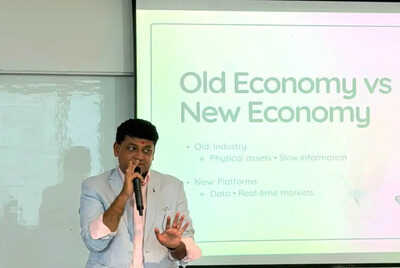
He explained that the old economy was largely built on physical assets such as factories, machinery, and tangible production, where industries created goods and the media simply reported on what already existed. In contrast, the new economy is driven by data, technology, and intangible assets. Companies like Amazon and Meta Platforms demonstrate how value today can be created through digital ecosystems, information, and platforms rather than traditional manufacturing.
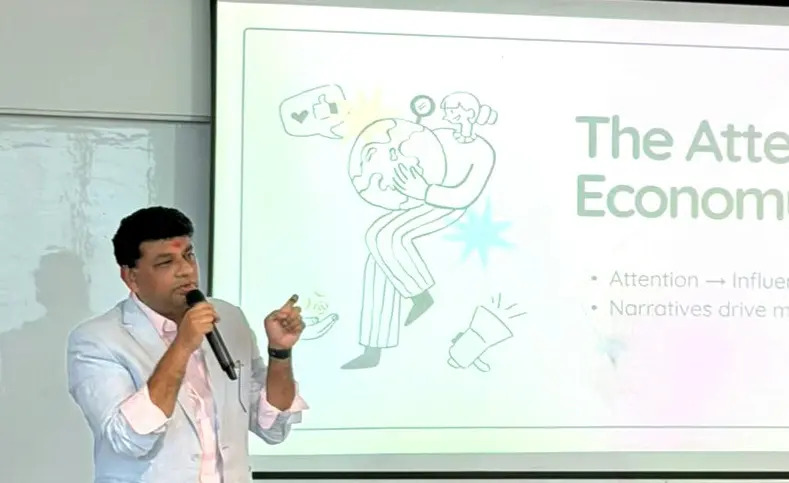
Mr. Alexander also discussed the rise of the attention economy, where attention itself has become a powerful currency. According to him, the process begins with gaining attention, which eventually builds influence, and that influence attracts capital. Unlike earlier times when businesses required large financial investments to begin, today, individuals or companies that command attention and influence can attract investors and opportunities more easily.
Another important concept highlighted in the session was narrative capital—the idea that markets are increasingly driven by stories and perceptions surrounding a company rather than just financial performance. Through examples such as the GameStop (GME ) phenomenon and the growing excitement around Artificial Intelligence , he illustrated how powerful narratives can influence investor behaviour even before actual financial outcomes are realised.
The discussion also touched upon Indian examples. The Paytm IPO was presented as a case of hype meeting market reality, while the story around the Adani Group showed how information and perception can lead to dramatic market volatility. On the other hand, Zerodha was highlighted as a company that successfully built its narrative around trust, transparency, and simplicity.
Concluding the session, Mr Alexander shared five key principles for aspiring journalists reporting on the modern economy: follow where the capital flows, understand the technology behind industries, separate narrative from reality, prioritise credibility over speed, and think globally. He emphasised that in an era where markets move through information and narratives shape perception, journalists
carry a critical responsibility to ensure accuracy, context, and truth in their reporting.
(The writer is a first-yearMass Communication student with a deep interest in reading and creative writing. Through her writing, she hopes to explore different perspectives and connect with readers in a simple yet meaningful way.)
On 10 March 2025, the
The morning began with the session when Dhiraj Sir took the mic and welcomed everyone. He briefly spoke about the new economy, highlighting how technological advancements are transforming businesses, markets, and the overall economic system, while also shaping opportunities for job seekers.
He then introduced Lovejeet Alexander, Director – New Economy at Bloomberg, expressing gratitude for his presence and noting his 25+ years of experience in the media and business ecosystem. Encouraging students to stay curious and keep the discussion interactive, he then handed the session over to
economy.
He explained that the old economy was largely built on physical assets such as factories, machinery, and tangible production, where industries created goods and the media simply reported on what already existed. In contrast, the new economy is driven by data, technology, and intangible assets. Companies like Amazon and Meta Platforms demonstrate how value today can be created through digital ecosystems, information, and platforms rather than traditional manufacturing.
Mr. Alexander also discussed the rise of the attention economy, where attention itself has become a powerful currency. According to him, the process begins with gaining attention, which eventually builds influence, and that influence attracts capital. Unlike earlier times when businesses required large financial investments to begin, today, individuals or companies that command attention and influence can attract investors and opportunities more easily.
Another important concept highlighted in the session was narrative capital—the idea that markets are increasingly driven by stories and perceptions surrounding a company rather than just financial performance. Through examples such as the GameStop (
The discussion also touched upon Indian examples. The Paytm IPO was presented as a case of hype meeting market reality, while the story around the Adani Group showed how information and perception can lead to dramatic market volatility. On the other hand, Zerodha was highlighted as a company that successfully built its narrative around trust, transparency, and simplicity.
Concluding the session, Mr Alexander shared five key principles for aspiring journalists reporting on the modern economy: follow where the capital flows, understand the technology behind industries, separate narrative from reality, prioritise credibility over speed, and think globally. He emphasised that in an era where markets move through information and narratives shape perception, journalists
carry a critical responsibility to ensure accuracy, context, and truth in their reporting.
(The writer is a first-year