TSOM Partners with IN-SPACe to Launch Course on Space Communication
Times of Bennett | Updated: Mar 08, 2026 13:14
Correspondent: Shreya
As India’s space missions continue to capture global attention, an important question arises: how can the gap between complex satellite data and public understanding be bridged?Bennett University ’s Times School of Media (TSOM), in collaboration with the Indian National Space Promotion and Authorisation Centre (IN-SPACe ), recently launched an intensive five-day course titled “Communication and Public Engagement in the Space Sector” to address this growing need.
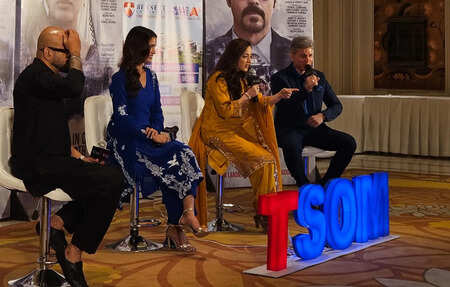
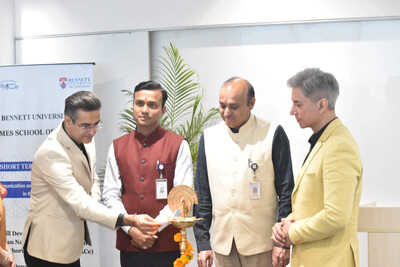
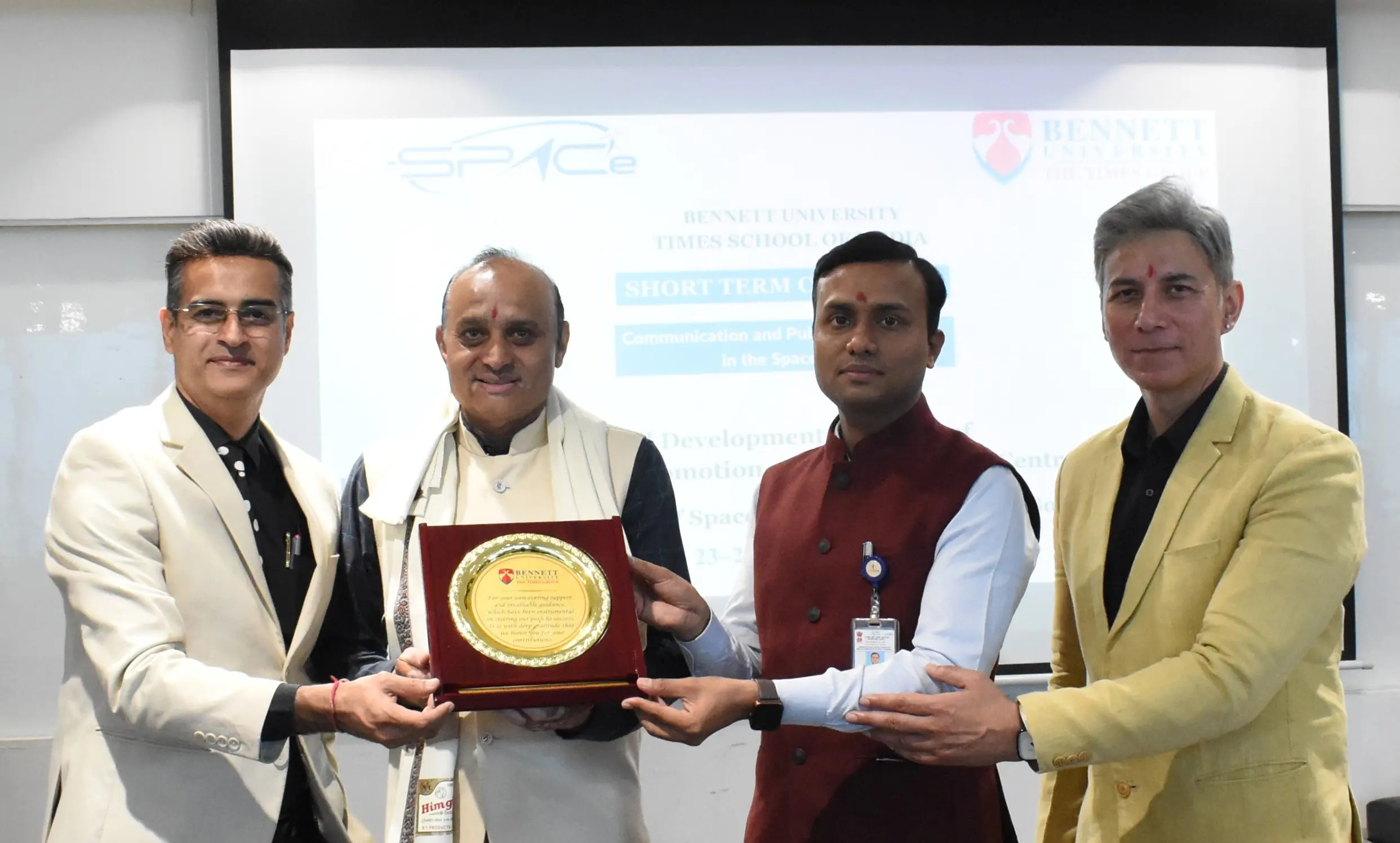
The programme was inaugurated in the presence of Dr. Vinod Kumar, Director of the Promotion Directorate at IN-SPACe;Gaurav Kumar , Assistant Director of Public Relations and Communication at IN-SPACe; Prof. Dr.
Sumit Narula, Dean of the Times School of Media; and Deputy Dean Dr. Dhiraj Singh, who both emphasised the university’s commitment to specialised media
education.
Organised under IN-SPACe’s skill development initiative, the event brought together media professionals, academics, and space experts to discuss the expanding nexus between space science, technology, and
communication.
The primary aim of the programme is to enhance public awareness of India’s rapidly expanding space sector while educating participants about emerging technologies, responsible communication, and scientific literacy. During the inaugural sessions, senior representatives from IN-SPACe and Bennett University stressed the importance of translating complex space technologies into narratives that can be understood by the public.
One of the major highlights of the initial sessions was an exploration of how high-speed algorithms are transforming real-time decision-making in space exploration. Industry experts explained the crucial
role algorithms play in real-time data processing, autonomous decision-making, satellite imaging, and navigation systems. Since space missions operate under extreme conditions, computational speed and accuracy are critical, making algorithm optimisation and verification a key area of focus.
This discussion was closely linked to the concepts of Human-in-the-Loop (HITL) and Hardware-in-the-Loop (HIL) systems. Hardware-in-the-loop testing integrates actual hardware components with simulated environments, allowing engineers to test performance and reliability before deployment in space
missions. Human-in-the-loop systems, on the other hand, ensure that human judgement remains part of automated frameworks, particularly in high-risk missions where contextual awareness and ethical considerations are essential.
Another important area of discussion focused on algorithms used for acquiring and validating data in space environments. Experts highlighted the importance of data verification and validation, considering the
enormous volumes of information generated daily by satellites. Ensuring accuracy before public dissemination is vital, particularly when satellite data is used for scientific research, navigation, and disaster management.
The sessions also explored the role of humanoid robotics in space missions, with particular reference to India’s humanoid Vyommitra, developed for the Gaganyaan mission. Experts discussed how humanoid robots can
assist astronauts, conduct experiments, and operate in hazardous environments, thereby reducing risks to human life during space missions.
Further discussions examined the functioning of Global Positioning System (GPS) technology in space, where specialised modifications are required due to orbital mechanics and signal limitations. These sessions
helped participants understand the complex technological framework that supports modern navigation and satellite communication systems.
Participants also revisited the scientific legacy of the ancient Indian mathematician and astronomer Aryabhata in the context of modern space science. His accurate calculation of Pi and his assertion that the Earth rotates on its axis were recognised as landmark contributions to the history of scientific thought.
“Aryabhata’s scientific temperament and mathematical precision continue to inspire India’s space journey,” said Dr. Vinod Kumar, Director at IN-SPACe, highlighting the enduring relevance of India’s ancient knowledge traditions in contemporary scientific advancements.
By connecting India’s historical astronomical achievements with modern technological innovations, the course emphasised the need for responsible, informed, and engaging communication in the space sector. Expert lectures, interactive workshops, and collaborative discussions marked the five-day programme, strengthening India’s scientific communication ecosystem while raising awareness about the country’s rapidly evolving space industry.
(This article is written by Shreya, a passionate writer with a strong interest in political PR, news reporting, and strategic
communication)
As India’s space missions continue to capture global attention, an important question arises: how can the gap between complex satellite data and public understanding be bridged?
The programme was inaugurated in the presence of Dr. Vinod Kumar, Director of the Promotion Directorate at IN-SPACe;
Sumit Narula, Dean of the Times School of Media; and Deputy Dean Dr. Dhiraj Singh, who both emphasised the university’s commitment to specialised media
education.
Organised under IN-SPACe’s skill development initiative, the event brought together media professionals, academics, and space experts to discuss the expanding nexus between space science, technology, and
communication.
The primary aim of the programme is to enhance public awareness of India’s rapidly expanding space sector while educating participants about emerging technologies, responsible communication, and scientific literacy. During the inaugural sessions, senior representatives from IN-SPACe and Bennett University stressed the importance of translating complex space technologies into narratives that can be understood by the public.
One of the major highlights of the initial sessions was an exploration of how high-speed algorithms are transforming real-time decision-making in space exploration. Industry experts explained the crucial
role algorithms play in real-time data processing, autonomous decision-making, satellite imaging, and navigation systems. Since space missions operate under extreme conditions, computational speed and accuracy are critical, making algorithm optimisation and verification a key area of focus.
This discussion was closely linked to the concepts of Human-in-the-Loop (HITL) and Hardware-in-the-Loop (HIL) systems. Hardware-in-the-loop testing integrates actual hardware components with simulated environments, allowing engineers to test performance and reliability before deployment in space
missions. Human-in-the-loop systems, on the other hand, ensure that human judgement remains part of automated frameworks, particularly in high-risk missions where contextual awareness and ethical considerations are essential.
Another important area of discussion focused on algorithms used for acquiring and validating data in space environments. Experts highlighted the importance of data verification and validation, considering the
enormous volumes of information generated daily by satellites. Ensuring accuracy before public dissemination is vital, particularly when satellite data is used for scientific research, navigation, and disaster management.
The sessions also explored the role of humanoid robotics in space missions, with particular reference to India’s humanoid Vyommitra, developed for the Gaganyaan mission. Experts discussed how humanoid robots can
assist astronauts, conduct experiments, and operate in hazardous environments, thereby reducing risks to human life during space missions.
Further discussions examined the functioning of Global Positioning System (GPS) technology in space, where specialised modifications are required due to orbital mechanics and signal limitations. These sessions
helped participants understand the complex technological framework that supports modern navigation and satellite communication systems.
Participants also revisited the scientific legacy of the ancient Indian mathematician and astronomer Aryabhata in the context of modern space science. His accurate calculation of Pi and his assertion that the Earth rotates on its axis were recognised as landmark contributions to the history of scientific thought.
“Aryabhata’s scientific temperament and mathematical precision continue to inspire India’s space journey,” said Dr. Vinod Kumar, Director at IN-SPACe, highlighting the enduring relevance of India’s ancient knowledge traditions in contemporary scientific advancements.
By connecting India’s historical astronomical achievements with modern technological innovations, the course emphasised the need for responsible, informed, and engaging communication in the space sector. Expert lectures, interactive workshops, and collaborative discussions marked the five-day programme, strengthening India’s scientific communication ecosystem while raising awareness about the country’s rapidly evolving space industry.
(This article is written by Shreya, a passionate writer with a strong interest in political PR, news reporting, and strategic
communication)