ASER '21: Pandemic triggers problem for private schools
Times of Bennett | Updated: Jan 25, 2022 15:17

By ASHISH AGARWAL
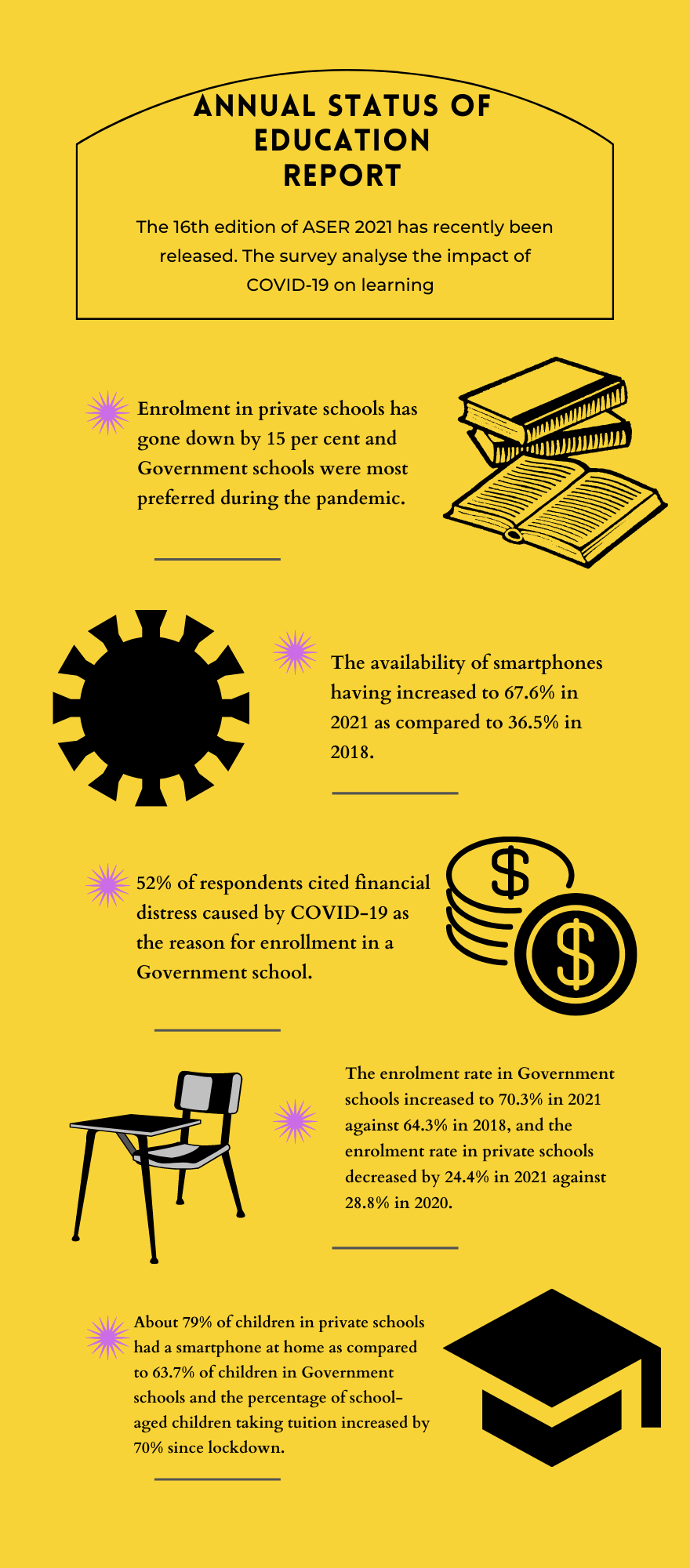
BULANDSHAHR : The 16th edition of the Annual Status of Education Report has, through a nationwide survey, analyzed the impact of COVID-19 on learning patterns. The report, unveiled in a recent webinar, says that enrolment in private schools has gone down by 15 per cent and government schools were most preferred during the pandemic. It also talks about the availability of smartphones having increased to 67.6% in 2021 as compared to 36.5% in 2018.
In the survey, 52% of respondents cited financial distress caused byCOVID-19 as the reason for enrolment in a government school. The enrolment rate in government schools increased to 70.3% in 2021 against 64.3% in 2018, and the enrolment rate in private schools decreased by 24.4% in 2021 against 28.8% in 2020.
About 79% of children in private schools had a smartphone at home as compared to 63.7% of children in government schools and the percentage of school-aged children taking tuition increased by 70% since lockdown.
 “Of all the groups the pandemic has hurt, children are the most poignant. Special effort needs to be made by the government, including budgetary allocations, to undo the harm these two years have caused to them. It is good that Niti Aayog is also looking for swift remedies to our slide in the Global Hunger Index, with the experience gained on enforced online
 education , perhaps the pedagogy could be changed to make computers a bigger source of learning. The shift from private to government schools may take time to reverse, as household earnings slowly recover,” Anita Singhal, a student counselor with Azad Public School, Bulandshahr , said.
TheASER , facilitated by the Pratham Education Foundation , is the oldest annual survey in the country. It is highly regarded for the range of information it provides on basic learning levels at the elementary level and uses the 2011 census as a sampling frame. It continues to be an important national source of information about children's foundation skills across the country. The ASER (rural) report was published on November 17, 2021, in an online event.
Every year from 2005 to 2014, then every two years until 2018, the ASER talked of the educational status of children in rural India and their ability to perform basic reading and numeracy activities.
“Last year, COVID-19 interrupted this trajectory, along with so much else. But with schools being closed since March 2020, understanding the effect of the pandemic on schools, families, and children was crucial. To address the need for large-scale nationally representative data on the impact of the pandemic on children'seducation , in 2020, ASER developed an entirely new design, consisting of a phone-based survey that explored children's access to learning opportunities. With the pandemic extending into yet another year, field-based survey operations were still not possible on a national scale,” Wilima Wadhwa , director of the ASER Centre, said at the webinar.
“The survey, conducted in September-October 2021, explores how children in the 5-16 age group studied at home since the onset of the pandemic and the challenges schools face as they reopen,” she said.
ASER 2021 was conducted in 25 states and three Union Territories. It reached 76,706 households and 75,234 children in the age group of 5-16 years, as well as teachers from 7,299 government schools offering primary grades. The ASER also suggested some policies related to the effect of school closure on children must be formulated as to cope with these problems.
Reaching parents at the proper level is critical to understanding how they could assist their children. Children are doing a whole lot of special sports at home; a lot of those are furnished by family members and private tutors similar to schools. Effective ways of hybrid knowledge needs to be advanced, the report also said.
The percentage of youngsters attending private tuition classes shot up during the pandemic. This might lead to a larger learning gap between students who can and cannot have enough money for paid tuition. This, the report added needed to be tackled on an urgent basis to bridge the gap.
In the survey, 52% of respondents cited financial distress caused by
About 79% of children in private schools had a smartphone at home as compared to 63.7% of children in government schools and the percentage of school-aged children taking tuition increased by 70% since lockdown.
The
Every year from 2005 to 2014, then every two years until 2018, the ASER talked of the educational status of children in rural India and their ability to perform basic reading and numeracy activities.
“Last year, COVID-19 interrupted this trajectory, along with so much else. But with schools being closed since March 2020, understanding the effect of the pandemic on schools, families, and children was crucial. To address the need for large-scale nationally representative data on the impact of the pandemic on children's
“The survey, conducted in September-October 2021, explores how children in the 5-16 age group studied at home since the onset of the pandemic and the challenges schools face as they reopen,” she said.
ASER 2021 was conducted in 25 states and three Union Territories. It reached 76,706 households and 75,234 children in the age group of 5-16 years, as well as teachers from 7,299 government schools offering primary grades. The ASER also suggested some policies related to the effect of school closure on children must be formulated as to cope with these problems.
Reaching parents at the proper level is critical to understanding how they could assist their children. Children are doing a whole lot of special sports at home; a lot of those are furnished by family members and private tutors similar to schools. Effective ways of hybrid knowledge needs to be advanced, the report also said.
The percentage of youngsters attending private tuition classes shot up during the pandemic. This might lead to a larger learning gap between students who can and cannot have enough money for paid tuition. This, the report added needed to be tackled on an urgent basis to bridge the gap.